
An office chair is easy to underestimate.
For a business, however, choosing the right office chair isn’t simply a matter of finding something that looks professional or fits within a particular budget. Employees may spend 7–9 hours a day sitting and working, which means the chair becomes one of the most frequently used pieces of workplace equipment.
A poorly selected chair can affect comfort, posture, concentration, and employee experience. On the other hand, a well-designed ergonomic office chair can provide better support and make long working hours more comfortable.
For businesses purchasing chairs in bulk, there is another consideration: the right chair has to work for many different people, not just one person sitting in a showroom for five minutes.
This guide explains what businesses should consider when choosing ergonomic office chairs, including features, chair types, materials, adjustability, pricing factors, bulk purchasing, and how to select the right office furniture supplier.
What Is an Ergonomic Office Chair?
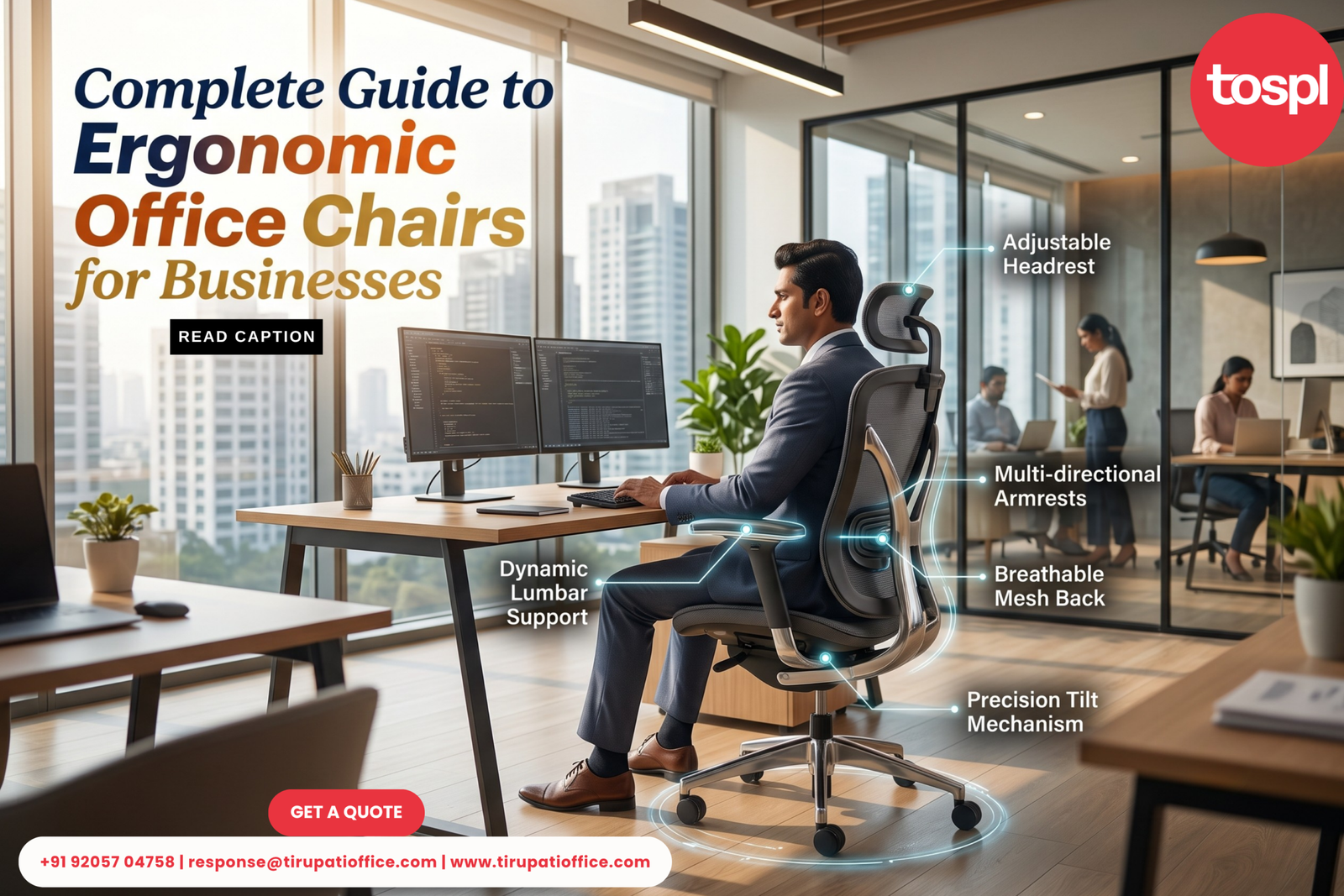
An ergonomic office chair is designed to support the user’s body and provide adjustable features that allow the seating position to be adapted to the individual.
Unlike a basic office chair, an ergonomic chair typically focuses on:
- Proper back support
- Lumbar support
- Adjustable seat height
- Appropriate seat depth
- Armrest positioning
- Backrest movement
- Reclining or tilt functionality
- Comfortable cushioning
- Breathable materials
The objective isn’t to find a chair that is “soft.”
The objective is to find a chair that supports the employee while allowing them to work comfortably throughout the day.
Why Ergonomic Office Chairs Matter for Businesses
When a company purchases 50, 100, or even 500 chairs, the decision has a much bigger impact than the furniture budget alone.
Employees interact with their chairs every working day.
That makes seating an important part of the workplace experience.
1. Better Employee Comfort
Comfort matters when employees are sitting for extended periods.
An ergonomic chair can provide appropriate support for the back, shoulders, arms, and legs while allowing employees to adjust their seating position.
2. Support for Different Users
No two employees have exactly the same body dimensions.
One employee may be taller, another shorter. One may prefer a more upright position, while another may require greater recline.
This is why adjustability is one of the most important features of an ergonomic office chair.
Businesses should avoid choosing chairs that provide only one fixed seating position.
3. Better Workplace Experience
Office furniture contributes to how employees experience their workplace.
A comfortable, well-designed workspace communicates that employee needs have been considered.
This doesn’t mean expensive furniture automatically creates a better workplace.
It means the furniture should be appropriate for the work being performed.
4. Long-Term Value
Businesses shouldn’t evaluate an office chair only by its purchase price.
A chair’s value also depends on:
- Expected lifespan
- Maintenance requirements
- Warranty
- Replacement parts
- Frequency of use
- Ergonomic features
- Ease of repair
- After-sales support
A lower-priced chair that needs frequent replacement may ultimately cost more than a durable commercial-grade chair.
Key Features to Look for in an Ergonomic Office Chair
1. Adjustable Seat Height
Seat height should allow employees to position their feet comfortably on the floor while maintaining an appropriate relationship between their knees and desk.
A chair with adjustable height is therefore preferable to a fixed-height chair for workplaces with different users.
2. Lumbar Support
The lower back needs appropriate support while sitting.
A chair with adjustable or well-designed lumbar support can help employees maintain a more supported sitting position.
For businesses purchasing chairs in bulk, look for chairs that can accommodate different users rather than relying on a single fixed lumbar position.
3. Adjustable Armrests
Armrests can help support the arms and shoulders when working at a desk.
Ideally, users should be able to position the armrests according to their height and working style.
Adjustable armrests can be particularly useful in shared or flexible workspaces.
4. Backrest Support
The backrest should provide adequate support across the user’s back.
A good office chair should also allow some movement rather than forcing the employee into a completely rigid position.
5. Recline and Tilt Mechanism
Employees don’t necessarily remain in exactly the same position throughout the day.
A chair with an appropriate tilt or recline mechanism allows users to change their posture and seating angle.
This can improve comfort during different types of work.
6. Seat Depth
Seat depth is often ignored when businesses evaluate office chairs.
If a seat is too deep, shorter users may struggle to sit comfortably while maintaining proper back support.
If it is too shallow, taller users may not receive adequate support.
For a workplace with a diverse workforce, adjustable seat depth can be a valuable feature.
7. Breathable Mesh Back
Mesh office chairs have become popular in modern workplaces because the material allows greater airflow around the back.
This can make mesh seating particularly suitable for employees who spend long periods sitting.
However, businesses shouldn’t choose a chair simply because it has a mesh back.
The quality of the mesh, frame, lumbar support, seat construction, and mechanism still matters.
8. Seat Cushion
The seat should provide sufficient support without becoming excessively soft.
For commercial environments, consider:
- Cushion density
- Fabric quality
- Edge design
- Durability
- Ease of maintenance
The ideal seat is not necessarily the softest one.
Mesh Office Chairs vs Upholstered Chairs
One of the most common decisions businesses face is whether to choose mesh or upholstered office chairs.
| Feature | Mesh Office Chair | Upholstered Office Chair |
|---|---|---|
| Airflow | Generally higher | Lower |
| Appearance | Modern | Traditional/premium |
| Maintenance | Usually easier | Depends on fabric |
| Long-hour use | Can be comfortable | Can be comfortable |
| Design options | Many contemporary designs | Wide range |
| Best suited for | Modern corporate workspaces | Executive & traditional offices |
Neither is universally better.
The right choice depends on your office environment, budget, usage, design preferences, and employee requirements.
Types of Ergonomic Office Chairs
Businesses rarely need only one type of chair.
Different roles and areas may require different seating solutions.
Task Chairs
Designed for everyday desk-based work.
Ideal for:
- IT teams
- Operations
- Administration
- Customer support
- Back-office teams
High-Back Chairs
Provide greater upper-back and head support.
They are often used in:
- Management offices
- Executive offices
- Long-duration workspaces
Mid-Back Chairs
A practical choice for general workstations where head support isn’t essential.
They can be suitable for employees who primarily perform desk-based work.
Executive Chairs
Executive chairs generally focus more heavily on appearance, cushioning, materials, and a larger seating profile.
They are commonly used in:
- Director cabins
- Senior management offices
- Executive rooms
- Conference Chairs
Conference room chairs have different requirements because employees typically use them for meetings rather than continuous desk work.
Here, design, comfort, and ease of movement become important considerations.
How to Choose the Right Ergonomic Chair for Different Employees
A common mistake is assuming that one chair model should be used everywhere.
Instead, divide your requirements.
Workstations
Prioritise:
- Ergonomics
- Adjustability
- Durability
- Breathability
- Long-hour comfort
Manager Cabins
Consider:
- Ergonomics
- Premium appearance
- Reclining functionality
- Additional adjustability
Executive Offices
Consider:
- Ergonomics
- Material quality
- Design
- Build quality
- Long-term usage
Meeting Rooms
Prioritise:
- Comfort
- Appearance
- Space efficiency
- Ease of movement
This approach allows businesses to spend where it actually matters instead of using the same specification everywhere.
What Makes a Good Office Chair for 8–9 Hour Workdays?
If employees spend most of their day at their desks, the chair should offer more than basic cushioning.
Look for:
Adjustable height
To accommodate different users and desk heights.
Lumbar support
To provide support to the lower back.
Adjustable armrests
To allow better arm and shoulder positioning.
Backrest movement
To allow users to change position during the day.
Breathable material
Particularly useful in warm environments.
Durable mechanism
Important for chairs that are adjusted and used repeatedly.
Quality base and casters
The base and wheels experience regular movement and load, so build quality matters.
Ergonomics Is More Than the Chair
This is an important point businesses often miss.
Even the best ergonomic office chair cannot compensate for a poorly planned workstation.
Employee comfort depends on the entire workstation setup.
Consider:
- Chair height
- Desk height
- Monitor position
- Keyboard and mouse placement
- Lighting
- Legroom
- Cable management
- Workspace layout
For example, if an employee has an ergonomic chair but the monitor is positioned too low, they may still spend the day in an uncomfortable posture.
Therefore, businesses should think in terms of an ergonomic workstation, not just an ergonomic chair.
How Many Office Chairs Should a Business Buy?
The answer depends on the organisation’s working model.
Consider:
- Total employees
- Number of workstations
- Hybrid employees
- Shift-based employees
- Meeting rooms
- Visitor seating
- Future expansion
For example, a company with 100 employees may not necessarily require exactly 100 identical chairs if some employees work remotely or share workstations.
At the same time, businesses should maintain a small buffer when appropriate so that replacements or expansion don’t create an immediate procurement problem.
Buying Office Chairs in Bulk: What Businesses Should Check
Bulk purchasing requires a different approach from buying a single chair.
Before placing an order, evaluate:
Product Quality
Check:
- Frame
- Base
- Casters
- Mechanism
- Mesh/fabric
- Foam
- Armrests
- Hardware
Warranty
Understand exactly what is covered.
Ask about:
- Mechanism warranty
- Frame warranty
- Parts
- Replacement process
- Service turnaround
Availability
If you’re furnishing an office with 100+ chairs, ensure the supplier can provide the required quantity within the project timeline.
Consistency
The chairs supplied should match the approved sample in terms of specification, finish, and configuration.
Installation
For large office projects, professional installation can help ensure the furniture is assembled correctly and efficiently.
How Much Does an Ergonomic Office Chair Cost in India?
There isn’t one fixed price for ergonomic office chairs.
Prices can vary significantly depending on:
- Chair type
- Brand
- Materials
- Ergonomic features
- Mechanism
- Adjustability
- Warranty
- Quantity
- Customisation
- Delivery
- Installation
A basic chair may cost considerably less than a premium commercial-grade ergonomic chair.
For businesses, the better approach is to define the requirement first and then compare quotations based on specification and total value, rather than comparing only the final price.
For bulk purchases, businesses may also receive different pricing depending on quantity and project requirements.
How to Compare Office Chair Quotations
Suppose three vendors provide quotations.
Vendor A: ₹8,000
Vendor B: ₹11,000
Vendor C: ₹15,000
It would be a mistake to immediately assume Vendor A offers the best deal.
Instead, compare:
- Chair mechanism
- Lumbar support
- Armrest adjustment
- Seat material
- Mesh quality
- Base material
- Warranty
- Service
- Installation
- Expected lifespan
A ₹15,000 chair and an ₹8,000 chair may look similar in a quotation but have very different specifications.
Always compare like-for-like.
Common Mistakes Businesses Make When Buying Office Chairs
1. Choosing Only on Price
This is probably the most common mistake.
The cheapest chair isn’t necessarily the most economical choice over several years.
2. Buying Without Testing
If possible, evaluate physical samples before placing a large order.
Employees will be using these chairs every day.
3. Selecting One Model for Everyone
Different employees and roles can have different requirements.
4. Ignoring Adjustability
A chair that looks ergonomic but has limited adjustment may not work equally well for different users.
5. Ignoring After-Sales Support
With hundreds of chairs in an office, eventually some components will require servicing.
The supplier’s service capability matters.
6. Buying Chairs Before Planning the Workspace
Chair selection should be part of overall office planning.
Desk height, workstation configuration and seating should work together.
Questions to Ask Your Office Chair Supplier
Before finalising an order, ask:
Is the chair designed for commercial use?
What ergonomic adjustments are available?
What is the warranty period?
Are replacement parts available?
Can you supply the required quantity?
What is the expected delivery timeline?
Do you provide installation?
Do you provide after-sales service?
Can you provide a product sample?
Can you support future requirements?
These questions can help businesses avoid problems after the purchase.
Why Businesses Should Work With an Experienced Office Furniture Partner
When you’re purchasing one chair, the supplier’s role is relatively simple.
When you’re furnishing an entire office, it becomes much more complicated.
A commercial office furniture partner may need to coordinate:
- Product selection
Seating requirements - Workstations
- Layout
- Delivery
- Installation
- Timelines
- Multiple departments
- Future expansion
- After-sales support
That’s why experience becomes particularly important for large office projects.
The right partner doesn’t simply ask:
“How many chairs do you need?”
They should also ask:
“How will these chairs be used?”
Why Choose Tirupati Office Systems for Ergonomic Office Chairs?
At Tirupati Office Systems (TOSPL), we understand that office seating is part of a larger workspace.
With 22+ years of experience in the office furniture industry, we work with businesses and institutions to provide workplace solutions based on their requirements.
Our office seating solutions can include:
- Ergonomic office chairs
- Mesh office chairs
- Executive chairs
- Manager chairs
- Task chairs
- Visitor chairs
- Conference chairs
For larger projects, our team can also support businesses with workstations, office furniture, commercial flooring, and other workspace requirements.
From requirement understanding and product selection to delivery and installation, the objective is to make the procurement process easier for businesses.
Frequently Asked Questions
Are ergonomic office chairs worth the investment?
For employees who spend several hours working at a desk every day, investing in appropriate ergonomic seating can improve comfort and workplace experience. Businesses should evaluate the chair based on its features, durability, usage and long-term value.
Is a mesh office chair better than a cushioned chair?
Not necessarily. Mesh chairs offer better airflow, while upholstered chairs can provide a different seating feel and appearance. The right choice depends on the office environment and user requirements.
What should I look for in an ergonomic office chair?
Look for adjustable height, appropriate lumbar support, comfortable seat design, adjustable armrests, backrest movement, durable construction and suitable materials.
How long should an office chair last?
There is no universal lifespan because it depends on construction quality, usage frequency, maintenance and environment. Commercial-grade chairs designed for intensive workplace use are generally preferable for corporate environments.
Can businesses buy ergonomic chairs in bulk?
Yes. Office furniture suppliers commonly handle bulk requirements for corporate offices, institutions, healthcare organisations, educational facilities and other commercial workplaces.
Should I buy the same chair for every employee?
Not always. While standardising models can simplify procurement and maintenance, different departments and roles may have different seating requirements.
Do ergonomic chairs require maintenance?
Like any frequently used piece of office furniture, ergonomic chairs may eventually require maintenance or replacement of components. Before purchasing in bulk, check the supplier’s warranty and after-sales support.
Final Checklist Before Buying Ergonomic Office Chairs
Before approving your purchase, make sure you have evaluated:
☑ Employee count and seating requirements
☑ Expected future growth
☑ Chair type
☑ Seat height adjustment
☑ Lumbar support
☑ Armrest adjustment
☑ Backrest and tilt mechanism
☑ Seat material
☑ Mesh quality
☑ Base and caster quality
☑ Warranty
☑ Replacement parts
☑ Delivery timeline
☑ Installation
☑ After-sales support
☑ Total cost of ownership
Final Thoughts
Choosing an ergonomic office chair isn’t about finding the chair with the most features.
It’s about finding the right combination of ergonomics, durability, functionality, design and value for your workplace.
For an individual buyer, the decision affects one person.
For a business, the decision can affect hundreds of employees and thousands of hours of workplace use.
That’s why office seating deserves more thought than simply comparing prices.
The right office chair isn’t an expense that fills a workstation. It’s part of the environment in which your people work every day.
Whether you’re setting up a new office, expanding your existing workspace, or replacing hundreds of chairs, Tirupati Office Systems can help you identify the right seating solution for your requirements.
Get in touch with TOSPL for ergonomic office chairs, bulk corporate orders, workspace solutions, delivery and installation support.
Share this :

Latest Article
Keep reading
Related Article
Complete Guide to Ergonomic Office Chairs for Businesses An office chair is easy to underestimate. For a business, however, choosing the right office chair isn’t
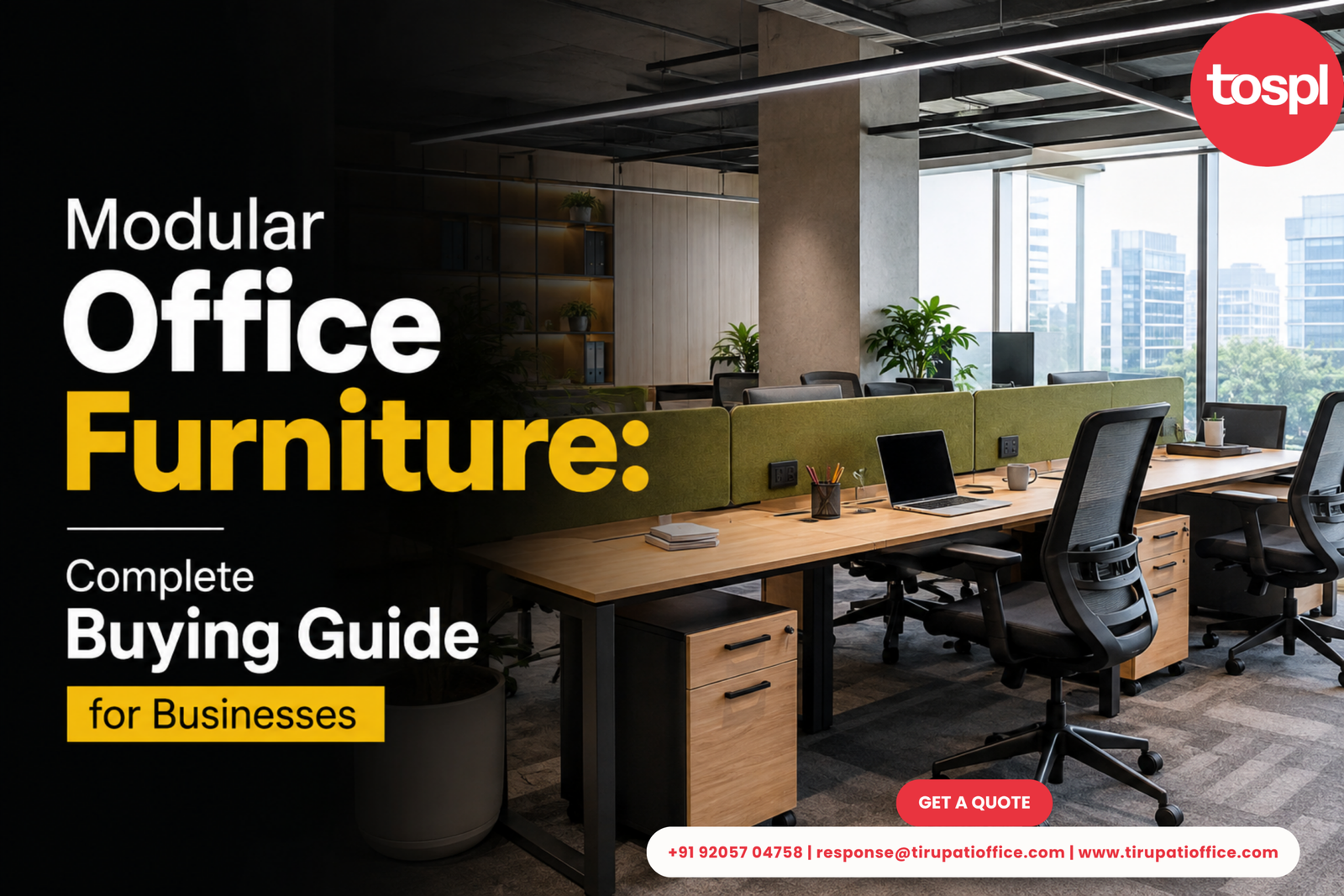
Modular Office Furniture: Complete Buying Guide for Businesses Setting up or upgrading an office is not simply about buying desks and chairs. The furniture you